
Cyprus Piloting
COMCY completes the first piloting sessions of the VRCARE project – bringing immersive VR-based training to childcare professionals, teachers, students, and elderly care teams across Cyprus.
What does it look like when innovation meets real-world care? Over the past weeks, COMCY brought the answer into focus – piloting the VRCARE immersive training scenarios across three distinct settings in Cyprus. The sessions marked a pivotal milestone for the project: taking carefully designed virtual environments out of the lab and testing them where they matter most, with the people who work and study at the heart of care.
Kindergarten Classrooms Step Into a New Dimension
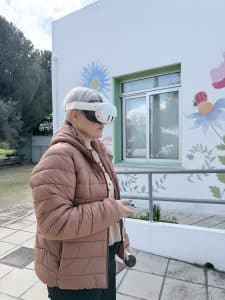
The first piloting session took place at Agia Varvara Public Kindergarten, where childcare providers experienced the VRCARE childcare scenarios first-hand using COMCY’s VR headsets. Stepping into realistic early childhood situations, teachers engaged with themes that define everyday care work: ethical decision-making, sensitive interactions with children, and the nuanced emotional landscape of an early education setting.
For many participants, it was their first encounter with VR as a learning tool. The discussions that emerged after each scenario were frank, insightful, and professionally rich. Participants challenged each other’s responses, examined their instincts, and considered how theory plays out when you are standing inside the situation rather than reading about it.
“Meaningful innovation in education isn’t theoretical. It’s tested, experienced, and refined in real settings – with real professionals willing to reflect honestly on what they see.”
Education Settings Join the Conversation
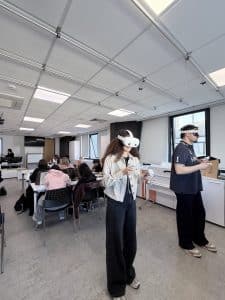
The second piloting session brought together trainers from Cyprus, as well as teachers and students from UNIC, opening the experience to an educational setting. This session explored VRCARE’s potential not only as a professional development tool but as a complement to healthcare education practices. Students preparing for careers in social and healthcare fields were able to bridge the gap between classroom theory and lived practice – experiencing the weight of care decisions before facing them in professional life. Teachers, in turn, reflected on how VR scenarios could sit alongside traditional pedagogical methods, enriching module design and discussion-based learning. The feedback gathered from this session will directly inform how VRCARE scenarios are adapted for integration.
Bringing VR Into Elderly Care
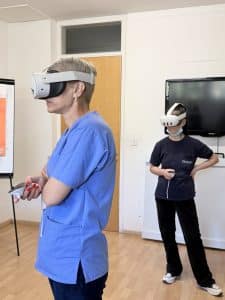
The third piloting session extended the VRCARE experience into a different care context entirely. At MATERIA Group, an elderly care centre, professionals working day-to-day with older adults stepped into VR scenarios designed around the sensory, ethical, and emotional dimensions of elder care – a field where empathy, attentiveness, and communication are as critical as clinical skill. Working with a population that requires a distinct sensitivity, these professionals brought a grounded, experienced perspective to their feedback. The immersive format created a protected space to pause, observe, and think carefully about practice.
The openness and professionalism of the MATERIA team made for an especially valuable session – one that underlined how relevant VR-based training can be across the full breadth of the care sector.
Key themes from participant feedback
- VR created a psychologically safe space to experience and examine difficult care situations without real-world risk.
- Ethical decision-making felt more immediate and personally meaningful in an immersive environment.
- Group discussions after scenarios were richer and more honest than those typically prompted by written case studies.
- Participants across all settings expressed enthusiasm for VR as an element of professional development.
- The technology felt accessible, even for those with no prior VR experience.
These insights will feed directly into the next phase of the VRCARE project, refining scenarios, informing facilitation guidelines, and shaping how the tool can be integrated sustainably into healthcare education programmes across partner countries.
Looking Ahead
The VRCARE piloting sessions represent a significant step forward – not just for the project, but for how we think about professional learning in care. They demonstrate that immersive technology, when thoughtfully designed and carefully facilitated, can do something exceptional: it can make learners feel what care requires, not just understand it intellectually.
COMCY is proud to be part of this work and deeply grateful to every participant who brought their time, openness, and professional expertise to these sessions. Your engagement is what makes innovation meaningful.
Find out more about VRCARE
Interested in the project, upcoming actions, or getting involved as a professional, educator, or institution? We’d love to hear from you.
Contact us at: antonia@comcy.eu
proud member of